Pengaruh Driver dengan Vga

Akibat driver ForceWare 196.75 WHQL, kipas pendingin di VGA Nvidia bisa melambat.

VIVAnews – Nvidia Corp. menyiarkan peringatan bahwa driver ForceWare terbaru mereka mengandung error yang bisa memunculkan masalah pada VGA. Salah satu contohnya adalah permasalahan pada kecepatan putar kipas pendingin.

Menurut laporan beberapa media, error pada driver ini bisa merusak, atau bahkan menggosongkan beberapa model kartu grafis tertentu.

“Kami memahami bahwa beberapa pengguna telah mengalami masalah kecepatan putar kipas akibat driver 196.75 WHQL driver yang diambil dari Nvidia.com,” sebut Nvidia pada pernyataannya, 12 Maret 2010. “Sampai kami dapat melakukan verifikasi dan mengatasi masalah ini, kami sarankan pengguna untuk tidak mendownload driver itu,” sebut Nvidia.

Nvidia juga meminta pengguna tetap memakai atau kembali ke driver ForceWare versi 196.21 WHQL.

Saat ini, driver versi 196.75 yang bermasalah tersebut sementara dihilangkan dari situs Nvidia. “Kami juga akan meminta seluruh partner kami menghapuskan driver tersebut dari situs mereka,” sebut Nvidia.

Bagi pengguna yang sudah terlanjur memasang driver terbaru, Nvidia juga membuatkan situs khusus yang menyediakan instruksi bagaimana melakukan downgrade ke driver versi lawas.

Menurut laporan dari sejumlah situs, driver ForceWare 196.75 bisa memperlambat atau bahkan mematikan kipas pendingin VGA. Hasilnya, VGA mulai menurunkan performa untuk membuat dirinya tetap dingin atau rusak akibat panas berlebih.

Sampai berita ini diturunkan, belum dapat diketahui berapa jumlah kartu grafis di seluruh dunia yang rusak akibat driver tersebut. Belum diketahui pula bagaimana Nvidia akan mengganti kerusakan dan bagaimana mereka membedakan kerusakan akibat driver tersebut atau akibat overclocking.

http://teknologi.vivanews.com/news/read/136114-pakai_nvidia__jangan_install_driver_terbaru_

Posted in Uncategorized | Leave a comment

Sejarah Pengembangan Infrastruktur Teknologi Informasi dan Komunikasi, dari Jarnet hingga Jardiknas menuju ke South East Asian Education Network (SEA EduNet)

Abstrak

Program pemanfaatan dan pengembangan Infrastruktur Teknologi Informasi dan Komunikasi (TIK) pada Departemen Pendidikan Nasional bukan sebuah program yang disusun “tiba masa tiba akal”, melainkan sebuah program yang telah dirintis dan dijalankan dalam beberapa tahap. Setiap tahapan disusun dengan mempertimbangkan kondisi pada saat itu dan keberlanjutannya pada masa-masa selanjutnya. Juga disusun hal-hal yang bersifat pendukung agar setiap program dapat berfungsi dan berjalan secara maksimal. Secara umum, program TIK di Depdiknas dimulai pada tahun 1999 melalui program Jaringan Internet (Jarnet), yang selanjutnya secara berturut-turut dikembangkan program Jaringan Informasi Sekolah (JIS), Wide Area Network (WAN) Kota, Information and Communication Technology Center (ICT Center), Jejaring Pendidikan Nasional (Jardiknas), dan untuk ke depan akan dikembangkan South East Asia Education Network (SEA EduNet).Seluruh program disusun dengan target yang jelas dan berkesinambungan, sehingga pengembangan infrastruktur teknologi informasi dan komunikasi di Indonesia dapat menjadi bagian dari infratruktur dunia. Infrastruktur ini juga dibarengi dengan pengembangan SDM yang sesuai, sehingga perangkat yang dikembangkan tidak menjadi tumpukan barang bekas yang tanpa makna. Diharapkan ke depan, pengembangan infratruktur tidak berhenti sampai pada level Asia Tenggara, tetapi mampu diperluas hingga ke level Asia dan Dunia. Hal ini akan menjadikan Indonesia sejajar dengan bangsa-bangsa lain dalam pemanfaatan dan pengembangan infrastruktur telkonologi informasi dan komunikasi dalam dunia pendidikan.

1. PENDAHULUAN

Bangsa Indonesia adalah bangsa yang besar, baik dari segi jumlah penduduk, luas wilayah, kekayaan alam dan sumber daya yang dimiliki.

Namun, kebesaran ini juga membawa beberapa tantangan di dalam mengelola seluruh sumberdaya yang ada dan untuk membawa negara ini semakin maju. Salah satu contoh tantangan adalah kondisi geografis negara Indonesia yang membentang dari Barat ke Timur, yang terdiri atas 14.000 pulau besar dan kecil serta diselingi dengan laut dan selat.

Kondisi ini pasti menyulitkan pelaksanaan beberapa program pemerintah yang membutuhkan kecepatan dan keluasan. Salah satu program utama yang mengalami tantangan ini adalah dunia pendidikan.

Sesuai dengan amanat Undang-Undang Dasar 1945, maka pendidikan adalah hak mutlak bagi warganegara Indonesia, dimana menjadi kewajiban bagi pemerintah untuk mewujudkan hal tersebut.

Berbagai daya dan upaya dikerahkan untuk memenuhi amat tersebut dan melibatkan seluruh alat yang dapat dimanfaatkan, termasuk pemanfaatan Teknologi Informasi dan Komunikasi (TIK).

Teknologi Informasi dan Komunikasi yang dikembangkan merupakan sebuah alat di dalam mencapai tujuan pedidikan, yaitu mencerdaskan anak bangsa, dimana di dalam pengembangannya terbagi atas beberapa hal, yaitu infrastruktur, SDM dan konten. Ketiga hal tersebut dilaksanakan secara paralel, karena satu sama lain harus saling mendukung untuk dapat menjadi sebuah alat yang lengkap untuk dimanfaatkan di dalam pencerdasan anak bangsa.

2. PEMBAHASAN

Khusus di Departemen Pendidikan Nasional, perkembangan infrastruktur, SDM dan konten di dalam Teknologi Informasi dan Komunikasi telah dimulai sejak abad 19 dan mengalami akselerasi yang cukup tinggi pada awal abad 20, yaitu pada tahun 1999 hingga saat ini.

Beberapa program pengembangan Teknologi Informasi dan Komunikasi khususnya Infrasruktur adalah:

  1. Jaringan Internet (Jarnet)
  2. Jaringan Informasi Sekolah (JIS)
  3. Wide Area Network Kota (WAN Kota)
  4. Information and Communication Technology Center (ICT Center)
  5. Indonesia Higher Education Network (Inherent)
  6. Jejaring Pendidikan Nasional (Jardiknas)
  7. South East Asian Education Network (SEA EduNet)

2.1 Jaringan Internet (2000)

Sebelum tahun 1999 sebenarnya secara parsial Departemen Pendidikan Nasional telah banyak melaksanakan kegiatan-kegiatan maupun menjalankan program yang berhubungan dengan Teknologi Informasi dan Komunikasi (TIK), utamanya untuk sarana komunikasi antar institusi dan otomatisasi pendataan. Beberapa diantaranya adalah pembuatan mailing list untuk komunikasi langsung antara pusat dengan daerah, menggalakkan pembuatan web site bagi sekolah untuk penyebaran informasi bagi sekolah tersebut serta penyusunan berbagai program pendataan berbasis TIK.

Namun, untuk pengembangan infrastruktur secara nasional dan dalam jumlah besar dilaksanakan oleh Direktorat Pendidikan Menengah Kejuruan (Dikmenjur) pada tahun 2000 dalam sebuah program yang disebut dengan Jaringan Internet atau Jarnet.

Latar belakang program ini adalah untuk mendukung pemercepatan internetisasi sekolah-sekolah di Indonesia khususnya pada Sekolah Menengah Kejuruan atau SMK. Hal ini karena SMK mulai diwajibkan untuk memiliki alamat email dan juga diminta untuk memiliki web site untuk sarana promosi sekolah masing-masing. Hal ini ditandai dengan perkembangan mailing list Dikmenjur yang pada awalnya hanya memiliki 2 orang anggota dan saat ini telah memiliki 5700 anggota dengan rata-rata komunikasi sebesar 600 email per-bulan.

Tujuan dari program ini adalah:

  1. Mempercepat pelaksanaan Internetisasi di SMK Negeri dan Swasta.
  2. Meningkatkan komunitas antar SMK.
  3. Mengoptimalkan penggunaan sarana dan prasarana yang dimiliki.
  4. Menyediakan sarana mendapatkan informasi terkini dan media pembelajaran bagi warga sekolah dan masyarakat umum.
  5. Menyediakan media promosi sekolah dalam rangka peningkatan minat/animo masyarakat terhadap SMK.
  6. Menjadikan jarnet bagian dari unit produksi agar mengembangkan warnet di sekolah.

Dengan demikian bantuan Jarnet di sekolah selain untuk memperkenalkan pemanfaatan teknologi informasi kepada segenap warga sekolah, juga untuk memberi dorongan agar sekolah dapat meningkatkan kinerjanya dengan mendayagunakan komputer yang ada, serta memperkenalkan Internet sebagai sarana mencari informasi dan sarana komunikasi yang efektif dan efisien.

Bantuan Jarnet ini dimaksudkan agar digunakan untuk pengadaan peralatan dan pelatihan pemasangan jaringan lokal (LAN) di sekolah.

Program pengembangan Jaringan Internet diperuntukkan bagi semua SMK Negeri/ Swasta di Kabupaten/Kota. Sampai dengan tahun 2003 terdapat 744 SMK yang sudah memiliki jaringan Internet melalui program Jarnet ini.

2.2 Jaringan Informasi Sekolah (2001 – 2002)

Senyampang dengan mulai menjamurnya kebutuhan terhadap internet yang diakibatkan oleh program Jarnet, maka kebutuhan infrastruktur dan sarana komunikasi juga semakin meningkat. Khusus mengenai infrastruktur, sebagian besar sekolah yang ada di kabupaten dan kota hanya memiliki komputer yang memiliki spesifikasi yang amat rendah. Bahkan banyak yang tidak memiliki harddisk.

Namun, karena minat yang amat tinggi, mereka juga berkeinginan untuk memiliki jaringan yang terhubung dengan internet.

Pada tahun 2001, pengembangan program cloning sedang marak dimana-mana, yaitu memanfaatkan 1 komputer yang memiliki kapasitas besar dan dibagi ke komputer-komputer lainnya melalui sistem jaringan. Sehingga sekolah tidak perlu membeli banyak komputer lagi, namun cukup membeli 1 komputer yang berkapasitas besar. Namun, pengetahuan ini masih amat terbatas, karena dibeberapa tempat menjadi sebuah lahan bisnis yang menggiurkan dan ditawarkan dengan harga yang cukup tinggi.

Oleh Depdiknas, program ini kemudian dipelajari dan disebarluaskan ke seluruh propinsi agar dapat diterapkan di sekolah-sekolah.

Disisi lain, perkembangan TIK yang cukup pesat membutuhkan SDM yang handal, juga membutuhkan sarana komunikasi dan diskusi bagi penggiat TIK di satu daerah, agar para guru yang memiliki hobi yang sama dapat berkumpul secara teratur setiap bulan untuk saling berbagi informasi dan pengetahuan di dalam bidang TIK. Untuk berkumpul ini juga dibutuhkan sebuah lokasi yang representatif, yang memiliki sarana dan prasarana dalam bidang TIK serta dapat dijadikan sebuah sekretariat.

Dengan dasar inilah, Depdiknas pusat mencoba untuk memacu hal tersebut dengan “memberikan kail” berupa bantuan untuk pelatihan awal dan merangsang pembentukan sekretariat TIK di masing-masing kabupaten/kota.

Program inilah yang disebut dengan Jaringan Informasi Sekolah atau disingkat JIS.

Mengapa disebut dengan Jaringan Informasi Sekolah ? Karena diharapkan fungsi utama dari prgoram ini adalah untuk menjaring seluruh sekolah di dalam satu wilayah agar saling berbagi informasi, khususnya dalam bidang Teknologi Informasi dan Komunikasi.

Peserta JIS ini tidak terbatas kepada SMK saja, namun diikuti oleh seluruh SLTA di daerah tersebut, SLTP dan beberapa SD. Syarat utama untuk ikut di dalam JIS adalah memiliki minat terhadap TIK

Hasil yang diharapkan dari program ini adalah:

  1. Terbentuknya Jaringan Informasi Sekolah di Kabupaten/Kota
  2. Terbentuknya Jaringan Lokal (Local Area Network) di masing-masing sekolah yang menjadi peserta pelatihan
  3. Tersosialisasikannya informasi mengenai program cloning PC, sehingga bagi sekolah yang memiliki komputer dengan spesifikasi rendah, tetap dapat dimanfaatkan untuk aplikasi perkantoran atau untuk internet

Hingga tahun 2003, telah terbentuk 154 JIS di seluruh Indonesia. Ini merupakan embrio pengembangan SDM untuk program TIK yang sejak program ini digulirkan menjadi lebih cepat lagi pengembangannya

2.3 Wide Area Notwork (WAN) Kota (2002-2003)

Perkembangan kebutuhan akan TIK sejak bergulirnya program Jarnet dan JIS semakin besar, utamanya kebutuhan terhadap koneksi internet yang digunakan untuk mempercepat proses pengiriman data dan informasi dari daerah ke pusat serta untuk proses pembelajaran.

Namun disisi lain, harga internet di Indonesia yang masih amat mahal menjadi pemikiran utama dari sekolah-sekolah tersebut. Untuk bisa membiayai operasional sehari-hari saja masih amat sulit, apalagi harus menyisihkan dana setiap bulan untuk biaya internet.
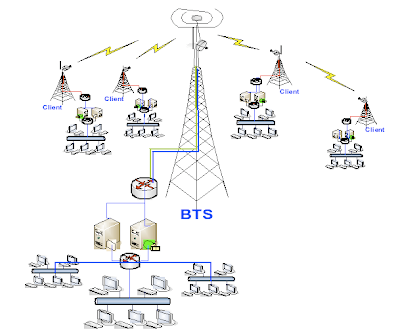
(Gambar 1. Sistem Jaringan WAN Kota)

Berdasarkan pemikiran tersebut, maka dikembangkanlah program WAN Kota, yang mencoba menghubungkan jaringan lokal di semua sekolah yang berada pada satu wilayah dan kemudian memasang koeksi internet pada salah satu simpul di daerah tersebut. Hal ini akan mengakibatkan biaya internet yang seharusnya hanya diatnggung oleh satu sekolah menjadi tanggungan bersama. Ini akan meringankan dan memudahkan sekolah-sekolah tersebut untuk turut serta menikmati koneksi internet.

Secara umum, fungsi dan manfaat program WAN Kota adalah:

  1. wahana berbagi (sharing) sumber daya data, informasi, dan program pendidikan;
  2. media komunikasi berbasis web atau multimedia antar lembaga pendidikan yang dibangun, dikelola, dan dikembangkan secar mandiri, kolektif, dan sistematis oleh semua lembaga pendidikan yang terlibat di dalam jejaring tersebut;
  3. infrastruktur pemelajaran jarak jauh (e-learning) dan pelayanan pemerintahan (e-government);
  4. sumber informasi dan komunikasi antar sekolah (SLTP, SMU dan SMK);
  5. pusat penyimpanan (server) modul pembelajaran;
  6. pusat pelatihan teknologi informasi dan komunikasi bagi masyarakat sekitarnya;
  7. digital library (perpustakaan berbasis komputer) yang dapat diakses semua sekolah di Kabupaten/Kota.

Secara umum, teknologi yang digunakan untuk program WAN Kota ini adalah teknologi Wireless IEEE 801.11 a/b/g yang memanfaatkan frekwensi 2,4 Ghz. Dengan penggunakan frekwensi yang free inilah, maka setiap sekolah hanya bermodalkan satu set antena Grid Parabolic ataupun menggunakan antena kaleng dan wajanbolic yang dirakit sendiri sudah dapat menikmati koneksi internet yag murah.

Dengan program ini, maka bermunculan juga sentra-sentra perakitan perangkat 2,4 Ghz di beberapa tempat, sehingga menggerakkan indutri kecil di daerah tersebut. Juga di beberapa lokasi, program ini disandingkan dengan RT/RW Net, sehingga pengguna internet tidak terbatas pada sekolah saja, melainkan juga masyarakat umum.

Hingga tahun 2003, telah terbentuk 31 WAN Kota di Indonesia.

2.4 ICT Center (2004 – 2006)

Program WAN Kota yang telah dikembangkan pada tahun 2002 hingga tahun 2003 akhirnya dirasakan hanya menitikberatkan kepada aspek perangkat keras dan jaringan saja, sedangkan pengembangan TIK tidak hanya terdiri atas kedua aspek tersebut. Pengembangan SDM juga hanya berputar kepada institusi yang menjadi lokasi WAN Kota, sehingga mulai dipikirkan untuk memperluas fungsi dan tugas dari WAN Kota menjadi sebuah institusi lain yang mampu menjadi pusat TIK di daerah dan bermanfaat secara luas bagi masyarakat di sekitarnya.

Berdasarkan pemikiran inilah, lahir sebuah program dan institusi dengan nama Information and Communication Technology (ICT) Center yang berfungsi sebagai Pusat Pendidikan, Pelatihan dan Pengembangan Teknologi Informasi dan Komunikasi di Kabupaten/Kota.

Untuk mempersenjatai fungsi tersebut, maka ICT Center dibentuk dengan infrastruktur yang melebihi WAN Kota, karena fungsu utamanya bukan hanya sekedar menghubungkan LAN di da satu wilayah saja, melainkan meluas kepada fungsi Capacity Bulding.

Perangkat yang diberikan kepada masing-masing ICT Center adalah satu set tower dan perangkat server 2,4 Ghz untuk membagi koneksi internet yang dimiliki, satu atau dua paket laboratorium komputer, dan perangkat pendukung jaringan lainnya, seperti VoIP Phone, Router, Switch dan lain-lain. Khusus ICT Center tahun 2005 malah diberikan bantuan koneksi selama 6 bulan melalui VSAT dengan bandwidth 128 Kbps 1:1 dengan ISP Indosat M2.

Berbagai program pelatihan telah dilaksanakan oleh seluruh ICT Center ini, dan sebagian berkolaborasi dengan pemerintah daerah maupun institusi lainnya. Di beberapa tempat, ICT Center malah sudah menjadi sebuah kebutuhan daerah, sehingga pemanfaatan perangkat yang dimiliki tidak hanya dari sekolah itu sendiri namun sudah amat meluas hingga ke masyarakat umum.

Hingga tahun 2008 ini, total ICT Center di seluruh Indonesia adalah 430 Unit

2.5 Inherent (2006 – 2007)

Direktorat Jenderal Pendidikan Tinggi juga turut menggeliat di dalam pengembangan TIK dan tidak kalah dengan Direktorat Jenderal Pendidikan Dasar dan Menengah. Sebenarnya, sejak tahun 90-an, sudah banyak perguruan tinggi yang secara parsial maupun kelompok kecil telah mengembangkan infrastruktur TIK di kampus masing-masing. Yang amat terkenal adalah ITB dengan berbagai risetnya untuk bidang internet dan jaringan lokal.

Secara nasional, infrastruktur yang dibangun untuk menghubungkan seluruh perguruan tinggi dibangun pada tahun 2006, dalam bentuk program Indonesian Higher Education Network atau Inherent.

Program INHERENT menghubungkan 32 perguruan tinggi sebagai backbone utama dimana perguruan tinggi lainnya dapat terhubung ke PT backbone tersebut apabila hendak terhubung dalam satu sistem jaringan.
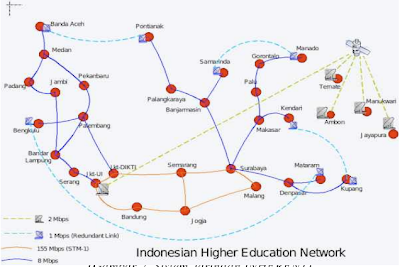
(Gambar 2. Sistem Jaringan INHERENT)

Karena tujuan utama dari sistem ini adalah untuk riset dan pengembangan, maka jalur data yang disiapkan cukup besar, bahkan mencapai 155 Mbps dengan link yang terkecil mencapai 2 Mbps.

2.6 Jejaring Pendidikan Nasional (2006 – sekarang)

Program ICT Center dan WAN Kota yang dibangun hingga tahun 2006 telah berhasil membangun jaringan lokal di dalam masing-masing kabupaten kota, serta telah membentuk komunitas di dalam bidang TIK.

Selanjutnya, untuk menggabungkan seluruh ICT Center, WAN Kota dan Institusi pendidikan lainnya di seluruh Indonesia, pada tahun 2006 dikembangkan program Jejaring Pendidikan Nasional atau Jardiknas.

Untuk memudahkan pengelolaan, Jardiknas dibagi atas 4 zona, yaitu Zona Kantor Dinas dan Institusi, Zona Perguruan Tinggi, Zona Sekolah, dan Zona Personal (Guru dan Siswa)

(Gambar 3. Sistem Jaringan Jardiknas)

Seluruh lokasi terhubung dengan teknologi MPLS dan dikelola oleh 3 NOC, dimana seluruh NOC dihubungkan dengan link internasional dan IIX sebesar 200 Mbps.

Hingga akhir tahun 2007, telah terhubung 1.014 titik institusi dan 11.825 sekolah dengan Jardiknas.

2.7 SEA EduNet ( 2008 )

Rencana pengembangan ke depan adalah mengintegrasikan jejaring yang telah dibentuk di Indonesia dengan negara-negara tetangga, agar dapat dilaksanakan sharing knowledge dengan lebih intensif. Hal ini bertujuan agar seluruh institusi kita memiliki wawasan yang lebih mengglobal.

Salah satu teknologi yang saat ini sedang dijajaki oleh Depdiknas, utamanya oleh institusi Southeast Asian Ministers of Education Organization Regional Open Distance Learning Centre (SEAMOLEC) adalah teknologi multicast, yang menggunakan perangkat parabola untuk downstream dan teresterial untuk upstream.

Teknologi ini amat sesuai dengan kondisi geografis di Indonesia, yang bergunung-gunung dan masih sulit dijangkau secara merata dengan koneksi kabel.

(Gambar 4. Sistem Jaringan SEA EduNet)

Diharapkan pada tahun 2008, sudah dapat diujicobakan pada seluruh Propinsi di Indonesia.

3. PENUTUP

3.1 Kesimpulan

Pengembangan Infrastruktur TIK pada Departemen Pendidikan  Nasonal dilakukan secara bertahap dan berjenjang sesuai dengan perkembangan teknologi dan kebutuhan lapangan.   Dengan pengembangan infrastruktur ini maka pengelolaan pendidikan di Indonesia dapat lebih efektif dan efisien.

3.2 Rekomendasi

Integarasi sistem Jaringan yang saat ini telah dibangun dengan memanfaatkan dana rakyat harus terus dijaga, utamanya didalam setiap pengembangan program ke depan, agar tidak terkesan “membongkar pondasi” setiap ada kebijakan yang baru. Selain itu, pengembangan konten yang menjadi alat transportasi yang memanfaatkan infrastruktur ini harus lebih diperkaya, sehingga pemanfaatannya menjadi lebih optimal.

Sejarah Pengembangan Infrastruktur Teknologi Informasi dan Komunikasi, dari Jarnet hingga Jardiknas menuju ke South East Asian Education Network (SEA EduNet)
Posted in Uncategorized | Leave a comment

Web 3.0 Inovasi Terbaru

Dunia maya (baca: Internet) telah banyak mempengaruhi kehidupan manusia dewasa ini. Semakin banyak orang yang menggantungkan perkembangan informasinya kepada Internet, sehingga teknologi yang dipergunakan dalam pembangunan sebuah situs web pun terus berkembang. Dari era pertama web dikembangkan (Web 1.0), dimana pengunjung hanya bisa mencari (searching) dan melihat-lihat (browsing) data informasi yang ada di web, kemudian bergeser pada era pengembangan web kedua (Web 2.0) di mana pengunjung mulai dapat melakukan interaksi dengan diatur oleh sistem yang ada pada web. Jenis interaksi yang dapat dilakukan pada era kedua ini antara lain untuk saling bertukar informasi (sharing), eksploitasi informasi, dan juga pembuatan komunitas-komunitas online seperti yang marak saat ini, seperti Friendster, Multiply, YouTube, dan lain-lain. Masing masing komunitas ini mempunyai kepentingannya sendiri dalam saling bertukar data maupun informasi yang mereka himpun. Dalam era inilah sebenarnya interaksi sosial dalam dunia maya mulai dikembangkan. Dan mulai dari era ini pulalah ide untuk mengembangkan aspek sosial sebuah web mulai dipikirkan.

Aspek sosial yang dimaksud, terutama adalah aspek interaksi. Bagaimana sebuah web dapat memberikan sebuah interaksi sesuai dengan kebutuhan informasi setiap pemakaianya, merupakan sebuah tantangan utama dikembangkannya versi Web 3.0 ini. Walaupun hanya bersifat virtual 3D, namun ternyata banyak yang mengharapkan perkembangan teknologi web ini dapat memenuhi kebutuhan setiap bidang informasi, bahkan setiap orang yang mengunjunginya.

Jika dianalogikan dalam kehidupan nyata, masyarakat kini ingin diperlakukan seperti seorang pengunjung butik dalam mendapatkan apa yang diinginkannya. Bukan seperti pengunjung supermarket yang dibiarkan mencari dan mendapatkan sendiri barang yang dinginkannya. Pengunjung sebuah web ingin dimengerti kemauannya oleh ‘toko’ penyedia informasi (dalam hal ini website). Inilah yang dimaksud dengan tantangan bagaimana sebuah web dapat mengerti dan membantu pengunjung dalam berinteraksi dengan semua informasi yang ada. Sehingga tak mengherankan jika kemudian ciri dari pengembangan web generasi ketiga ini adalah web yang bersifat ‘nyata’, benar-benar ada interaksi yang terjadi, kemudian dapat memberikan suggestion atau ‘anjuran’ kepada pengunjung dalam mendapatkan informasi yang diharapkannya, dan tentu saja juga tetap bersifat ‘provide’ atau mampu menyediakan informasi yang dibutuhkan.

Web 3.0 sendiri merupakan sebuah proyek pengembangan semantic web, yaitu sebuah sistem web yang dapat melacak setiap kaitan dari kata-kata yang terangkai, berkaitan dengan arti setiap kata yang dipakai. Tujuannya tentu saja agar web dapat menjadi media umum untuk bertukar informasi melalui dokumen-dokumen yang bahasanya dapat dimengerti oleh sistem, sehingga para pengunjung web dapat dengan mudah mencari data yang tepat atau minimal berkaitan dekat dengan apa yang kita maksud. Web 3.0 sendiri merupakan sebuah realisasi dari pengembangan sistem kecerdasan buatan (artificial intelegence) untuk menciptakan global meta data yang dapat dimengerti oleh sistem, sehingga sistem dapat mengartikan kembali data tersebut kepada pengunjung dengan baik.

Saat ini adaptasi Web 3.0 mulai dikembangkan oleh beberapa perusahaan di dunia seperti secondlife, Google Co-Ops, bahkan di Indonesia sendiri juga sudah ada yang mulai mengembangkannya, yaitu Li’L Online (LILO) Community.

Permasalahan lain yang potensial muncul adalah, sebagai teknologi masa depan, Web 3.0 juga membutuhkan kecepatan akses Internet yang memadahi dan spesifikasi komputer yang tidak enteng, hal ini disebabkan tak lain karena teknologi ini secara visual berbasis 3D. Sedangkan seperti yang kita tahu biaya akses Internet dengan kecepatan tinggi di Indonesia ini masih terbilang mahal bagi masyarakat umum. Belum lagi jika dihitung dari biaya spesifikasi perangkat komputer yang dibutuhkan, mungkin masyarakat Indonesia yang ingin menikmati kecanggihan layanan berbasis teknologi Web 3.0 masih harus menarik nafas penjang. Namun karena Web 3.0 sendiri masih dalam pengembangan, seiring dengan berlalunya waktu sebagai masyarakat Indonesia kita masih bisa mengharapkan bahwa biaya komunikasi, dalam hal ini koneksi Internet kecepatan tinggi akan semakin murah nantinya, sehingga terjangkau bagi masyarakat luas.

http://www.beritanet.com/Technology/web-30-semantic.html

Posted in Uncategorized | Leave a comment

Jaringan Nirkabel

Teknologi yang sangat berperan dalam pengembangan generasi nirkabel ini antara lain adalah teknologi Wi-Fi dan 3G.

Teknologi 3G
Teknologi 3G (Third Generation) merupakan teknologi nirkabel berkecepatan tinggi yang tidak membutuhkan access point karena 3G menggunakan sistem ponsel yang telah ada. Acces point sendiri adalah stasiun yang menerima dan mengirimkan data dari dan ke jaringan nirkabel. Penggunaan teknologi 3G ini dapat kita jumpai pada smartphone dan PDA keluaran terbaru saat ini. Dengan mempergunakan teknologi 3G ini kita dapat men-download movie, video dan game beresolusi tinggi. Di Amerika sendiri layanan ini disediakan oleh berbagai macam provider seperti Verizon, Cingular, Sprint, dan T-Mobile.

Teknologi Wi-Fi
Wi-Fi (Wireless Fidelity) merupakan sebuatan untuk beberapa standart yang masuk dalam kelompok standart 802.11 dalam transisi nirkabel yang dibuat oleh IEEE (Institute of Electrical and Electronics Engineers). Salah satu standart yang ada, 80.2.11b memungkinkan transmisi data tanpa kabel (nirkabel) dengan kecepatan 1 hingga 11 Mbps sejauh sekitar 90 meter dari acces point atau hot spot. Saat ini telah banyak fasilitas public yang telah dilengkapi dengan hot spot atau area terbuka ke jaringan Wi-Fi. Hotspot sendiri biasanya memperoleh akses Internet dari DSL, modem kabel, LAN T1, dan metode lainnya. Dari koneksi Internet yang didapatkan tersebut, kemudian disebarluaskan (broadcast) secara nirkabel sehingga kita dapat mengaksesnya mempergunakan perangkat mobile computer.

http://www.beritanet.com/Technology/Berita-IT/Wi-Fi-3G-generasi-nirkabel.html

Posted in Uncategorized | Leave a comment

Teknologi Informasi Digital

Tahun 1980 banyak orang berbicara soal mutu dan selama tahun 1990-an banyak orang mulai bicara tentang re-engineering, sedangkan yang terbaru sekarang ini tahun 2000-an orang berbicara tentang kecepatan. Seberapa cepat sifat dasar bisnis berubah, seberapa cepat bisnis menjadi obyek transaksi dan seberapa cepat sebuah akses informasi akan mengubah gaya hidup konsumen.
Perubahan-perubahan kecepatan informasi ini dapat terjadi karena adanya aliran informasi digital. Sudah 30 tahun kita ada di zaman informasi yang bergerak dalam wujud kertas, bahkan sampai sekarang penyebaran informasi menggunakan kertas masih sangat mendominasi. Tetapi walaupun demikian era sekarang ini perkembangan teknologi digital juga berkembang dengan sangat pesat, sekarang orang yang tinggal di perkotaan pasti sudah mengenal era digital ini.

Teknologi digital dapat menerima segala informasi dari angka, suara, teks , dan audio. Dari segala informasi yag masuk ini dapat disimpan, diproses, dan dikirim oleh perangkat yang kita sebut komputer dengan sangat cepat. Maka dari itu teknologi digital ini pasti akan terus mempengaruhi pola pikir manusia, di mana tuntutan kecepatan informasi akan menjadi sangat dibutuhkan. Dalam dunia digital konektivitas punya makna yang lebih luas daripada sekedar memungkinkan 2 orang atau lebih saling berhubungan. Untuk memenuhi kebutuhan konektivitas jaringan ini maka diciptakanlah ruang universal baru dimana orang dapat saling berbagi informasi, berkolaborasi, dan untuk berinteraksi niaga, dll. Teknologi ini dapat kita sebut sebagai Internet.

Internet menyediakan sebuah medium baru yang menyediakan kesegaran dan spontanitas teknologi seperti televisi dan telepon, kemudian menggabungkan semuanya dengan kedalaman dan keluasan jangkauan yang merupakan sifat dasar komunikasi lewat kertas. Kalau kita menggabungkan beberapa hal diatas dari kecepatan, dunia digital, dan Internet maka dapat disimpulkan sekarang ini dunia sedang membutuhkan suatu yang serba instan termasuk di dalamnya adalah informasi digital.

Agar informasi dapat menjadi hal yang paling mendasar dalam perusahaan Anda, berikut ini adalah 12 langkah kunci yang diperlukan :

Untuk Knowledge Work :

  • Usahakan agar komunikasi mengalir ke seluruh organisasi lewat email sehingga Anda dapat menanggapi suatu kabar dengan kecepatan refleks.
  • Pelajari data penjualan online untuk menemukan pola dan berbagi wawasan dengan mudah. Pahami trend keseluruhan dan personalkan jasa untuk tiap pelanggan.
  • Gunakan PC untuk analisis bisnis, pindahkan para pekerja berpengetahuan ke pekerjaan dengan tingkat berpikir lebih tinggi tentang produk, jasa, dan profitabilitas.
  • Gunakan piranti digital untuk menciptakan tim virtual lintas departemen yang dapat saling berbagi pengetahuan dan saling membangun gagasan dalam waktu nyata (real time) dengan cakupan mendunia. Gunakan sistem–sistem digital untuk mencatat sejarah perusahaan yang dapat digunakan oleh siapapun.
  • Ubahlah setiap proses yang menggunakan kertas ke proses digital agar kemacetan administratif dapat dihilangkan dan para pekerja berpengetahuan dapat mengerjakan tugas-tugas yang lebih penting.

http://www.beritanet.com/Business/digital_information_technology_1.html

Posted in Uncategorized | Leave a comment

Camera ‘looks’ through clothing

A camera that can “see” explosives, drugs and weapons hidden under clothing from 25 metres has been invented.

The ThruVision system could be deployed at airports, railway stations or other public spaces.

It is based on so-called “terahertz”, or T-ray, technology, normally used by astronomers to study dying stars.

Although it is able to see through clothes it does not reveal “body detail” or subject people to “harmful radiation”, according to the designers.

“It is totally and utterly passive – it receives only,” said a spokesperson for Thruvision.

The portable camera, which has already been sold to the Dubai Mercantile Exchange and Canary Wharf in London, will be shown off at the Home Office scientific development branch’s annual exhibition later this week.

Body glow

Unlike current security systems that use X-rays, the ThruVision system exploits terahertz rays, or T-rays.

This electromagnetic radiation is a form of low level energy emitted by all people and objects.

These are able to pass through clothing, paper, ceramics and wood but are blocked by metal and water.

The system works by collecting these waves and processing them to form an image which can reveal concealed objects.

“If I were to look at you in terahertz you would appear to glow like a light bulb and different objects glow less brightly or more brightly,” said the firm’s spokesperson.

“You see a silhouette of the form but you don’t see surface anatomical effects.”

In addition, the system does not involve any of the “harmful radiation associated with traditional X-ray security screening”, according to the firm.

The company has made previous versions of the camera, but the T5000, as it is known, is the first that works both indoors and out.

The system exploits technology originally developed at the government owned Rutherford Appleton Laboratory (RAL) in Oxfordshire.

“Astronomers use T-ray cameras that can see through dust and clouds in space, revealing what lies beyond,” explained Dr Liz Towns-Andrews, of the Science and Technology Facilities Council which runs RAL.

Other terahertz systems, developed by companies such as TeraView, are used to probe the structure of pharmaceutical compounds.

http://news.bbc.co.uk/2/hi/technology/7287135.stm

Posted in Uncategorized | Leave a comment

Tekno Untuk Ibu Rumah Tangga

Penemuan baru di bidang tekstil oleh peneliti di Universitas Monash, Australia ini tentunya berita bagus buat para ibu rumah tangga yang selalu mengeluh dan berharap ada baju yang bisa membersihkan dirinya sendiri sehingga pekerjaan rumah tangga bisa berkurang.

Para peneliti yang dipimpin oleh Walid Daoud, seorang peneliti kimia organik dan nanomaterial, menemukan cara melapisi kain dengan titanium dioxide nanocrystals, yang dapat memecah remah makanan dan kotoran yang mungkin menempel di pakaian apabila pakaian itu berada di bawah sinar matahari.

Mereka telah membuat serat alami seperti wool, sutera dan hemp yang akan secara otomatis membersihkan diri sendiri dari remah makanan, kotoran lain yang menempel di pakaian dan bahkan noda dari anggur merah ketika pakaian itu terkena sinar matahari.

Walaupun lapisan titanium dioxide nanoparticles itu bisa mengoksidasi bahan-bahan organik yang menodai pakaian, bahan nanopartikel tersebut tidak akan mendekomposisi wool dan tidak berbahaya untuk kulit manusia. Bahkan menurut Daoud, lapisan nanopartikel ini tidak akan mengubah bentuk dan nilai rasa dari bahan pakaian aslinya. Para peneliti optimis bahwa bahan pakaian yang dilapisi nanopartikel ini sudah akan ada di pasaran dalam waktu 2 tahun mendatang.

Jika Anda tertarik untuk mengetahui cara kerja nanopartikel membersihkan pakaian, silahkan baca artikel lengkapnya. Saya pribadi tidak sabar menunggu bahan pakaian itu beredar dipasaran, dan berharap harga jualnya cukup terjangkau

http://compactbyte.info/2008/03/13/pakaian-yang-mencuci-sendiri/

Posted in Uncategorized | Leave a comment

Mengenal Wolfram Alpha

WolframAlpha merupakan mesin komputasi pengetahuan yang baru diluncurkan pada tanggal 18 Mei 2008. Sekilas situs wolfram alpha akan membuat orang berpikir bahwa ini hanyalah salah satu mesin pencari, seperti Google atau Yahoo, namun Anda akan kagum dengan kemampuannya setelah mencobanya. Wolfram dapat menjawab pertanyaan-pertanyaan ilmiah, dan hasilnya pun langsung berupa fakta, bukan link-link ke suatu website.

Wolfram Alpha dapat menjawab pertanyaan seperti “who is the president of united states”, “when is the next solar eclipse in Indonesia”, atau “what is the distance between chiang mai and bandung”. Wolfram Alpha dapat menampilkan grafik fungsi, membandingkan saham dua perusahaan, menampilkan cuaca suatu kota, menampilkan struktur kimia, menyajikan peta, dsb. Tapi Wolfram Alpha juga masih belum sempurna, banyak pertanyaan sederhana yang belum bisa dijawab, tapi sebagai produk baru, kemampuannya sudah sangat menjanjikan. Bagi ilmuwan atau siswa/mahasiswa sains, Wolfram Alpha akan sangat berguna dalam melakukan riset.

Perlu dicatat bahwa Wolfram Alpha saat ini tidak menjelajah web untuk mencari jawaban atas suatu pertanyaan. Di Google, saya bisa mencari nama saya “Yohanes Nugroho”, dan akan muncul situs-situs yang saya miliki. Wolfram Alpha tidak memiliki kemampuan semacam itu, dan akan menjawab dengan “Wolfram|Alpha isn’t sure what to do with your input.”

Di balik layar, saat ini Wolfram Alpha menggunakan 10 ribu komputer untuk menjawab aneka pertanyaan. Jumlah ini masih jauh dibawah Google, jadi jangan heran jika terkadang permintaan Anda butuh waktu lama untuk memprosesnya. Selain versi publik, Wolfram Alpha juga akan dijual untuk entitas komersial sehingga bisa dipakai untuk menganalisis data pada suatu perusahaan, dan tentunya akan ada fitur-fitur yang tidak diberikan dalam versi publik.

http://compactbyte.info/2009/05/18/mengenal-wolframalpha/

Posted in Uncategorized | Leave a comment

Discribe Hacker

Hacker definition controversy

Currently, “hacker” is used in two main conflicting ways, one pejorative and one complimentary. The controversy is usually based on the assumption that the term originally meant someone messing about with something in a positive sense, that is, using playful cleverness to achieve a goal. But then, it is supposed, the meaning of the term shifted over the decades since it first came into use in a computer context and became to refer to computer criminals. As usage has spread more widely, the primary meaning of newer users conflicts with the original primary emphasis. In popular usage and in the media, computer intruders or criminals is the exclusive meaning today, with associated pejorative connotations. (For example, “An Internet ‘hacker’ broke through state government security systems in March.”) In the computing community, the primary meaning is a complimentary description for a particularly brilliant programmer or technical expert. (For example, “Linus Torvalds, the creator of Linux, is considered by some to be a hacker.”) A large segment of the technical community insist the latter is the “correct” usage of the word (see the Jargon File definition below). The mainstream media‘s current usage of the term may be traced back to the early 1980s. When the term was introduced to wider society by the mainstream media in 1983, even those in the computer community referred to computer intrusion as “hacking”, although not as the exclusive use of that word. In reaction to the increasing media use of the term exclusively with the criminal connotation, the computer community began to differentiate their terminology. Alternative terms such as “cracker” were coined in an effort to distinguish between those adhering to the historical use of the term “hack within the programmer community and those performing computer break-ins. Further terms such as “black hat“, “white hats” and “gray hats” developed when laws against breaking into computers came into effect, to distinguish criminal activities and those whose activities were the legal. However, since network news use of the term pertained primarily to the criminal activities despite this attempt by the technical community to preserve and distinguish the original meaning, the mainstream media and general public continue to describe computer criminals with all levels of technical sophistication as “hackers” and does not generally make use of the word in any of its non-criminal connotations.

As a result of this difference, the definition is the subject of heated controversy. The wider dominance of the pejorative connotation is resented by many who object to the term being taken from their cultural jargon and used negatively,[7] including those who have historically preferred to self-identify as hackers. Many advocate using the more recent and nuanced alternate terms when describing criminals and others who negatively take advantage of security flaws in software and hardware. Others prefer to follow common popular usage, arguing that the positive form is confusing and unlikely to become widespread in the general public. A minority still stubbornly use the term in both original senses despite the controversy, leaving context to clarify (or leave ambiguous) which meaning is intended. It is noteworthy, however, that the positive definition of hacker was widely used as the predominant form for many years before the negative definition was popularized. “Hacker” can therefore be seen as a shibboleth, identifying those who use the technically-oriented sense (as opposed to the exclusively intrusion-oriented sense) as members of the computing community.

A possible middle ground position has been suggested, based on the observation that “hacking” describes a collection of skills which are used by hackers of both descriptions for differing reasons. The analogy is made to locksmithing, specifically picking locks, which — aside from its being a skill with a fairly high tropism to ‘classic’ hacking — is a skill which can be used for good or evil. The primary weakness of this analogy is the inclusion of script kiddies in the popular usage of “hacker”, despite the lack of an underlying skill and knowledge base. Sometimes, hacker also is simply used synonymous to geek: “A true hacker is not a group person. He’s a person who loves to stay up all night, he and the machine in a love-hate relationship… They’re kids who tended to be brilliant but not very interested in conventional goals[…] It’s a term of derision and also the ultimate compliment.”[8]

Fred Shapiro thinks that “the common theory that ‘hacker’ originally was a benign term and the malicious connotations of the word were a later perversion is untrue.” He found out that the malicious connotations were present at MIT in 1963 already (quoting The Tech, a MIT Student Magazine) and then referred to unauthorized users of the telephone network,[9][10] that is, the phreaker movement that developed into the computer security hacker subculture of today.

In computer security, a hacker is someone who focuses on security mechanisms of computer and network systems. While including those who endeavor to strengthen such mechanisms, it is more often used by the mass media and popular culture to refer to those who seek access despite these security measures. That is, the media portrays the ‘hacker’ as a villain. Nevertheless, parts of the subculture see their aim in correcting security problems and use the word in a positive sense. They operate under a code, which acknowledges that breaking into other people’s computers is bad, but that discovering and exploiting security mechanisms and breaking into computers is still an interesting activity that can be done ethically and legally. Accordingly, the term bears strong connotations that are favorable or pejorative, depending on the context.

The subculture around such hackers is termed network hacker subculture, hacker scene or computer underground. It initially developed in the context of phreaking during the 1960s and the microcomputer BBS scene of the 1980s. It is implicated with 2600: The Hacker Quarterly and the alt.2600 newsgroup.

In 1980, an article in the August issue of Psychology Today (with commentary by Philip Zimbardo) used the term “hacker” in its title: “The Hacker Papers”. It was an excerpt from a Stanford Bulletin Board discussion on the addictive nature of computer use. In the 1982 film TRON, Kevin Flynn (Jeff Bridges) describes his intentions to break into ENCOM’s computer system, saying “I’ve been doing a little hacking here”. CLU is the software he uses for this. By 1983, hacking in the sense of breaking computer security had already been in use as computer jargon,[11] but there was no public awareness about such activities.[12] However, the release of the movie WarGames that year, featuring a computer intrusion into NORAD, raised the public belief that computer security hackers (especially teenagers) could be a threat to national security. This concern became real when, in the same year, a gang of teenage hackers in Milwaukee, Wisconsin, known as The 414s, broke into computer systems throughout the United States and Canada, including those of Los Alamos National Laboratory, Sloan-Kettering Cancer Center and Security Pacific Bank.[13] The case quickly grew media attention,[13][14] and 17-year-old Neal Patrick emerged as the spokesman for the gang, including a cover story in Newsweek entitled “Beware: Hackers at play”, with Patrick’s photograph on the cover.[15] The Newsweek article appears to be the first use of the word hacker by the mainstream media in the pejorative sense.

Pressured by media coverage, congressman Dan Glickman called for an investigation and began work on new laws against computer hacking.[16][17] Neal Patrick testified before the U.S. House of Representatives on September 26, 1983 about the dangers of computer hacking, and six bills concerning computer crime were introduced in the House that year.[18] As a result of these laws against computer criminality, white hat, grey hat and black hat hackers try to distinguish themselves from each other, depending on the legality of their activities. These moral conflicts are expressed in The Mentor‘s “The Hacker Manifesto“, published 1986 in Phrack.

Use of the term hacker meaning computer criminal was also advanced by the title “Stalking the Wily Hacker”, an article by Clifford Stoll in the May 1988 issue of the Communications of the ACM. Later that year, the release by Robert Tappan Morris, Jr. of the so-called Morris worm provoked the popular media to spread this usage. The popularity of Stoll’s book The Cuckoo’s Egg, published one year later, further entrenched the term in the public’s consciousness.


The computer security use is contrasted by the different understanding of hacker as a person who follows a spirit of playful cleverness and loves programming. It is found in an originally academic movement unrelated to computer security and most visibly associated with free software and open source. It also has a hacker ethic, based on the idea that writing software and sharing the result on a voluntary basis is a good idea, and that information should be free, but that it’s not up to the hacker to make it free by breaking into private computer systems. This hacker ethic was publicized and perhaps originated in Steven Levy‘s Hackers: Heroes of the Computer Revolution (1984). It contains a codification of its principles.

The programmer subculture of hackers disassociates from the mass media’s pejorative use of the word ‘hacker’ referring to computer security, and usually prefer the term ‘cracker’ for that meaning. Complaints about supposed mainstream misuse started as early as 1983, when media used “hacker” to refer to the computer criminals involved in the 414s case.[19]

In the programmer subculture of hackers, a computer hacker is a person who enjoys designing software and building programs with a sense for aesthetics and playful cleverness. The term hack in this sense can be traced back to “describe the elaborate college pranks that…students would regularly devise” (Levy, 1984 p. 10). To be considered a ‘hack’ was an honour among like-minded peers as “to qualify as a hack, the feat must be imbued with innovation, style and technical virtuosity” (Levy, 1984 p. 10) The MIT‘s Tech Model Railroad Club Dictionary defined hack in 1959 (not yet in a computer context) as “1) an article or project without constructive end; 2) a project undertaken on bad self-advice; 3) an entropy booster; 4) to produce, or attempt to produce, a hack(3).” “hacker” was defined as “one who hacks, or makes them.” Much of the TMRC’s jargon was later imported into early computing culture, because the club started using a DEC PDP-1 and applied its local model railroad slang in this computing context. Despite being incomprehensible to outsiders, the slang became popular in MIT’s computing environments outside the club. Other examples of jargon imported from the club are ‘losing’ “when a piece of equipment is not working”[20] and ‘munged’ “when a piece of equipment is ruined”.[20]

According to Eric S. Raymond,[21] the Open source and Free Software hacker subculture developed in the 1960s among ‘academic hackers’[22] working on early minicomputers in computer science environments in the United States.

Hackers were influenced by and absorbed many ideas of key technological developments and the people associated with them. Most notable is the technical culture of the pioneers of the Arpanet, starting in 1969. The PDP-10 machine AI at MIT, which was running the ITS operating system and which was connected to the Arpanet, provided an early hacker meeting point. After 1980 the subculture coalesced with the culture of Unix. Since the mid-1990s, it has been largely coincident with what is now called the free software and open source movement.

Many programmers have been labeled “great hackers,”[23] but the specifics of who that label applies to is a matter of opinion. Certainly major contributors to computer science such as Edsger Dijkstra and Donald Knuth, as well as the inventors of popular software such as Linus Torvalds (Linux), and Dennis Ritchie and Ken Thompson (the C programming language) are likely to be included in any such list; see also List of programmers. People primarily known for their contributions to the consciousness of the programmer subculture of hackers include Richard Stallman, the founder of the free software movement and the GNU project, president of the Free Software Foundation and author of the famous Emacs text editor as well as the GNU Compiler Collection (GCC), and Eric S. Raymond, one of the founders of the Open Source Initiative and writer of the famous text The Cathedral and the Bazaar and many other essays, maintainer of the Jargon File (which was previously maintained by Guy L. Steele, Jr.).

Within the computer programmer subculture of hackers, the term hacker is also used for a programmer who reaches a goal by employing a series of modifications to extend existing code or resources. In this sense, it can have a negative connotation of using inelegant kludges to accomplish programming tasks that are ugly, inelegant, and inefficient. This derogatory form of the noun “hack” derives from the everyday English sense “to cut or shape by or as if by crude or ruthless strokes” [Merriam-Webster] and is even used among users of the positive sense of “hacker”. In other words to “hack” at an original creation, as if with an axe, is to force-fit it into being usable for a task not intended by the original creator, and a “hacker” would be someone who does this habitually. (The original creator and the hacker may be the same person.) This usage is common in both programming and engineering. In programming, hacking in this sense appears to be tolerated and seen as a necessary compromise in many situations. Some argue that it should not be, due to this negative meaning; others argue that some kludges can, for all their ugliness and imperfection, still have “hack value”. In non-software engineering, the culture is less tolerant of unmaintainable solutions, even when intended to be temporary, and describing someone as a “hacker” might imply that they lack professionalism. In this sense, the term has no real positive connotations, except for the idea that the hacker is capable of doing modifications that allow a system to work in the short term, and so has some sort of marketable skills. There is always, however, the understanding that a more skillful, or technical, logician could have produced successful modifications that would not be considered a “hack-job”. The definition is similar to other, non-computer based, uses of the term “hack-job”. For instance, a professional modification of a production sports car into a racing machine would not be considered a hack-job, but a cobbled together backyard mechanic’s result could be. Even though the outcome of a race of the two machines could not be assumed, a quick inspection would instantly reveal the difference in the level of professionalism of the designers.

In a very universal sense, hacker also means someone who makes things work beyond perceived limits in a clever way in general, without necessarily referring to computers, especially at the MIT.[3] That is, people who apply the creative attitude of software hackers in fields other than computing. This includes even activities that predate computer hacking, for example reality hackers or urban spelunkers (exploring undocumented or unauthorized areas in buildings). One specific example are clever pranks[24] traditionally perpetrated by MIT students, with the perpetrator being called hacker. For example, when MIT students surreptitiously put a fake police car [1] atop the dome on MIT’s Building 10, that was a hack in this sense, and the students involved were therefore hackers. Another type of hacker — one who  — is now called a reality hacker . More recent examples of usage for almost any type of playful cleverness are wetware hackers (“hack your brain”), media hackers and “hack your reputation”.

[edit] Home computer hackers

Main article: Hacker (hobbyist)

In a third meaning, hacker refers to computer hobbyists who push the limits of their software or hardware. The home computer hacking subculture relates to the hobbyist home computing of the late 1970s, beginning with the availability of MITS Altair. An influential organization was the Homebrew Computer Club. However, its roots go back further to amateur radio enthusiasts. The amateur radio slang referred to creatively tinkering to improve performance as “hacking” already in the 1950s.[25]

A large overlaps between hobbyist hackers and the programmer subculture hackers existed during the Homebrew Club’s days, but the interests of both communities developed into different directions. Today, the hobbyists focus on commercial computer and video games, software cracking and exceptional computer programming (demo scene). Also of interest to some members of this group is the modification of computer hardware and other electronic devices, see modding.

[edit] Overlaps and differences

The main basic difference between programmer subculture and computer security hackers is their mostly separate historical origin and development. However, the Jargon File reports that considerable overlap existed for the early phreaking at the beginning of the 1970s. An article from MIT’s student paper The Tech used the term hacker in this context already in 1963 in its pejorative meaning for someone messing with the phone system.[9] The overlap quickly started to break when people joined in the activity who did it in a less responsible way.[26] This was the case after the publication of an article exposing the activities of Draper and Engressias.

According to Raymond, hackers from the programmer subculture usually work openly and use their real name, while computer security hackers prefer secretive groups and identity-concealing aliases.[27] Also, their activities in practice are largely distinct. The former focus on creating new and improving existing infrastructure (especially the software environment they work with), while the latter primarily and strongly emphasize the general act of circumvention of security measures, with the effective use of the knowledge (which can be to report and help fixing the security bugs, or exploitation for criminal purpose) being only rather secondary. The most visible difference in these views was in the design of the MIT hackers’ Incompatible Timesharing System, which deliberately didn’t have any security measures.

There are some subtle overlaps, however, since basic knowledge about computer security is also common within the programmer subculture of hackers. For example, Ken Thompson noted during his 1983 Turing Award lecture that it is possible to add code to the UNIX “login” command that would accept either the intended encrypted password or a particular known password, allowing a back door into the system with the latter password. He named his invention the “Trojan horse“. Furthermore, Thompson argued, the C compiler itself could be modified to automatically generate the rogue code, to make detecting the modification even harder. Because the compiler is itself a program generated from a compiler, the Trojan horse could also be automatically installed in a new compiler program, without any detectable modification to the source of the new compiler. However, Thompson disassociated himself strictly from the computer security hackers: “I would like to criticize the press in its handling of the ‘hackers,’ the 414 gang, the Dalton gang, etc. The acts performed by these kids are vandalism at best and probably trespass and theft at worst. … I have watched kids testifying before Congress. It is clear that they are completely unaware of the seriousness of their acts.”[28]

The programmer subculture of hackers sees secondary circumvention of security mechanisms as legitimate if it is done to get practical barriers out of the way for doing actual work. In special forms, that can even be an expression of playful cleverness.[29] However, the systematic and primary engagement in such activities is not one of the actual interests of the programmer subculture of hackers and it doesn’t have significance in its actual activities, either.[27] A further difference is that, historically, members of the programmer subculture of hackers were working at academic institutions and used the computing environment there. In contrast, the prototypical computer security hacker had access exclusively to a home computer and a modem. However since the mid-1990s, with home computers that could run Unix-like operating systems and with inexpensive internet home access being available for the first time, many people from outside of the academic world started to take part in the programmer subculture of hacking.

Since the mid-1980s, there are some overlaps in ideas and members with the computer security hacking community. The most prominent case is Robert T. Morris, who was a user of MIT-AI, yet wrote the Morris worm. The Jargon File hence calls him “a true hacker who blundered”.[30] Nevertheless, members of the programmer subculture have a tendency to look down on and disassociate from these overlaps. They commonly refer disparagingly to people in the computer security subculture as crackers, and refuse to accept any definition of hacker that encompasses such activities. The computer security hacking subculture on the other hand tends not to distinguish between the two subcultures as harshly, instead acknowledging that they have much in common including many members, political and social goals, and a love of learning about technology. They restrict the use of the term cracker to their categories of script kiddies and black hat hackers instead.

All three subcultures have relations to hardware modifications. In the early days of network hacking, phreaks were building blue boxes and various variants. The programmer subculture of hackers has stories about several hardware hacks in its folklore, such as a mysterious ‘magic’ switch attached to a PDP-10 computer in MIT’s AI lab, that, when turned off, crashed the computer.[31] The early hobbyist hackers built their home computers themselves, from construction kits. However, all these activities have died out during the 1980s, when the phone network switched to digitally controlled switchboards, causing network hacking to shift to dialing remote computers with modems, when pre-assembled inexpensive home computers were available, and when academic institutions started to give individual mass-produced workstation computers to scientists instead of using a central timesharing system. The only kind of widespread hardware modification nowadays is case modding.

An encounter of the programmer and the computer security hacker subculture occurred at the end of the 1980s, when a group of computer security hackers, sympathizing with the Chaos Computer Club (who disclaimed any knowledge in these activities), broke into computers of American military organizations and academic institutions. They sold data from these machines to the Soviet secret service, one of them in order to fund his drug addiction. The case could be solved when Clifford Stoll, a scientist working as a system administrator, found ways to log the attacks and to trace them back (with the help of many others). 23, a German film adaption with fictional elements, shows the events from the attackers’ perspective. Stoll described the case in his book The Cuckoo’s Egg and in the TV documentary The KGB, the Computer, and Me from the other perspective. According to Eric S. Raymond, it “nicely illustrates the difference between ‘hacker’ and ‘cracker’. Stoll’s portrait of himself, his lady Martha, and his friends at Berkeley and on the Internet paints a marvelously vivid picture of how hackers and the people around them like to live and how they think.”[32]

http://en.wikipedia.org/wiki/Hacker_%28computing%29

Posted in Uncategorized | Leave a comment

Hacker

What Is a Hacker?

The Jargon File contains a bunch of definitions of the term ‘hacker’, most having to do with technical adeptness and a delight in solving problems and overcoming limits. If you want to know how to become a hacker, though, only two are really relevant.

There is a community, a shared culture, of expert programmers and networking wizards that traces its history back through decades to the first time-sharing minicomputers and the earliest ARPAnet experiments. The members of this culture originated the term ‘hacker’. Hackers built the Internet. Hackers made the Unix operating system what it is today. Hackers run Usenet. Hackers make the World Wide Web work. If you are part of this culture, if you have contributed to it and other people in it know who you are and call you a hacker, you’re a hacker.

The hacker mind-set is not confined to this software-hacker culture. There are people who apply the hacker attitude to other things, like electronics or music — actually, you can find it at the highest levels of any science or art. Software hackers recognize these kindred spirits elsewhere and may call them ‘hackers’ too — and some claim that the hacker nature is really independent of the particular medium the hacker works in. But in the rest of this document we will focus on the skills and attitudes of software hackers, and the traditions of the shared culture that originated the term ‘hacker’.

There is another group of people who loudly call themselves hackers, but aren’t. These are people (mainly adolescent males) who get a kick out of breaking into computers and phreaking the phone system. Real hackers call these people ‘crackers’ and want nothing to do with them. Real hackers mostly think crackers are lazy, irresponsible, and not very bright, and object that being able to break security doesn’t make you a hacker any more than being able to hotwire cars makes you an automotive engineer. Unfortunately, many journalists and writers have been fooled into using the word ‘hacker’ to describe crackers; this irritates real hackers no end.

The basic difference is this: hackers build things, crackers break them.

If you want to be a hacker, keep reading. If you want to be a cracker, go read the alt.2600 newsgroup and get ready to do five to ten in the slammer after finding out you aren’t as smart as you think you are. And that’s all I’m going to say about crackers.

http://www.catb.org/esr/faqs/hacker-howto.html

Posted in Uncategorized | Leave a comment